
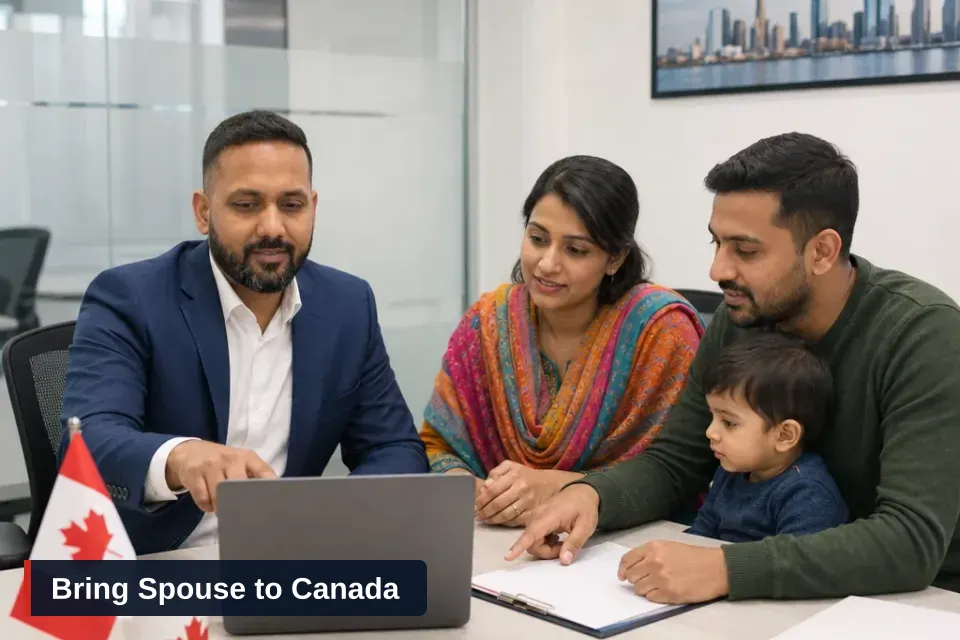
Yes — in most cases you can bring your spouse or common‑law partner and dependent children to Canada while you study. Your partner may be eligible for an open work permit, or they can come as a visitor; children can come as visitors or study with the correct permit. Below you’ll find who qualifies, the step‑by‑step application routes, documents to prepare, common mistakes VMC sees and where to check IRCC pages for the latest rules.
Who can come with you: spouse, common‑law partner and dependent children?
You can usually bring your spouse (married) or common‑law partner (living together in a conjugal relationship for at least one year) and dependent children under the immigration definitions. Dependents may need a study permit if they will attend primary or secondary school for longer periods. Whether your partner can work depends on the type and level of your study program and the permit they apply for.
Can I bring my spouse to Canada as an international student?
Short answer: yes, and often your spouse can apply for an open work permit that lets them work for most employers in Canada. If they are not eligible for work, they can come as a visitor but won’t be allowed to work. The correct path depends on your program (level, length and whether it’s at a designated learning institution) and your partner’s plans.
Which partners qualify for an open work permit and when?
- Common eligibility pattern: partners of full‑time international students at many public post‑secondary institutions or at private institutions authorised by a province often qualify for an open work permit.
- Program length matters: in some cases the student’s study program must be at a level and length that IRCC recognises (e.g. programs that would make the student eligible for a post‑graduation work permit).
- Where the student holds a study permit and is enrolled full‑time, the partner can usually apply from outside Canada, at the port of entry (if admissible) or from inside Canada—check IRCC guidance for current rules.
- If the student is doing distance learning from outside Canada, the rules for partner permits differ; remote/online study can affect eligibility.
Which documents you must prepare (checklist)
- 1Your current study permit or study permit approval letter (letter of introduction) and proof of enrolment at the DLI.
- 2Marriage certificate or evidence of common‑law relationship (shared lease, joint bank accounts, photos over time, affidavits).
- 3Passport pages and photos for your partner and children.
- 4Proof of funds showing you can support your partner and dependents (bank statements, sponsor letters, scholarship letters).
- 5Letter of explanation about why the partner is applying and plans while in Canada (work, visit, child care).
- 6If applying for an open work permit: completed application forms, biometrics (if required), and any police certificates/medical exams requested.
- 7For children applying to study: proof of enrollment in the local school or acceptance letter, and a copy of your study permit and proof of guardianship if required.
Step‑by‑step: how to apply for a spousal open work permit (common route)
- 1Confirm eligibility: check IRCC pages “Work permits for spouses or common‑law partners of international students” and that your program and DLI meet current criteria.
- 2Gather documents from the checklist above and scan clear, legible copies.
- 3Choose where to apply: from outside your home country, from inside Canada (if you already hold valid status), or at a port of entry (if eligible). IRCC lists which options are allowed.
- 4Complete the application: use the correct IRCC work permit application package for open work permits and pay biometrics and application fees where required.
- 5Submit online: IRCC prefers online applications. After submission, watch for requests for biometrics, police certificates or medical exams and respond quickly.
- 6If approved, your partner will receive a letter of introduction or a work permit document — keep these with travel documents. If refused, do not assume future applications will automatically succeed; review the refusal reasons and correct issues before reapplying.
Visitor visa vs spousal open work permit vs study permit for children (comparison)
Common mistakes VMC sees and how to avoid them
- Assuming any spouse automatically gets a work permit — eligibility depends on your program and DLI. Always check IRCC criteria first.
- Applying with incomplete proof of relationship — submit multiple types of evidence (joint accounts, photos, travel together, affidavits).
- Waiting to apply until arrival — some partners should apply before travel to avoid being refused at the border.
- Using outdated IRCC forms or fee amounts — IRCC updates forms and fees; download the package directly from IRCC.
- Not responding quickly to biometric or medical requests — delays can cause longer processing or refusals.
Where to check official rules and recent updates
Always confirm eligibility and current application instructions on the Government of Canada pages — for example: “Work permits for spouses or common‑law partners of international students” and “Visitors to Canada” on the IRCC website. Also check the list of designated learning institutions (DLI) on IRCC and any provincial pages for local school enrolment rules.
Frequently Asked Questions
Can my spouse work immediately after arrival?
If your spouse has an approved open work permit when entering Canada, they can start work when the permit is issued at the port of entry. If they enter as a visitor and later apply from inside Canada, they must wait for the permit approval before starting work.
Can my partner study in Canada too?
Yes. Your partner can apply for a study permit to enrol in school. If they plan to study short courses or part‑time, check if a study permit is required under IRCC rules.
What if my program is online or remote?
Remote study can affect your partner’s eligibility for an open work permit. IRCC’s rules treat distance or online learning differently, so confirm whether your enrolment counts as in‑Canada full‑time study.
Can dependent children work in Canada?
Children under the definition of dependent cannot work unless they qualify for a work permit in their own right (e.g., through a separate program). School‑aged children can attend primary/secondary school with the correct status.
If you plan to bring family with you, prepare relationship evidence and proof of funds early. Missing documents or an ineligible student program are the most common reasons partner work permits are refused.
Immigration rules change. If your case has complexities (previous refusals, unclear common‑law proof, medical or criminal issues), get advice before you apply to reduce delays and refusals. VMC offers consultations in person in Brampton or online to review your documents and options.
VMC Recommendation
Before you apply, have a licensed RCIC review your study permit, proof of enrolment and relationship documents to confirm whether your partner qualifies for an open work permit or should apply as a visitor. A short document review can help avoid common mistakes and unnecessary delays.
Licensed RCIC · VMC Immigration Services · CICC R705959
Sanjay Singh Kumar is a Regulated Canadian Immigration Consultant (RCIC) licensed by the College of Immigration and Citizenship Consultants (CICC). He has guided thousands of clients through Express Entry, PNP, work permits, and family sponsorships.
Follow our updates on Google: add VMC as a preferred source to see our immigration news more often in Google Top Stories.