
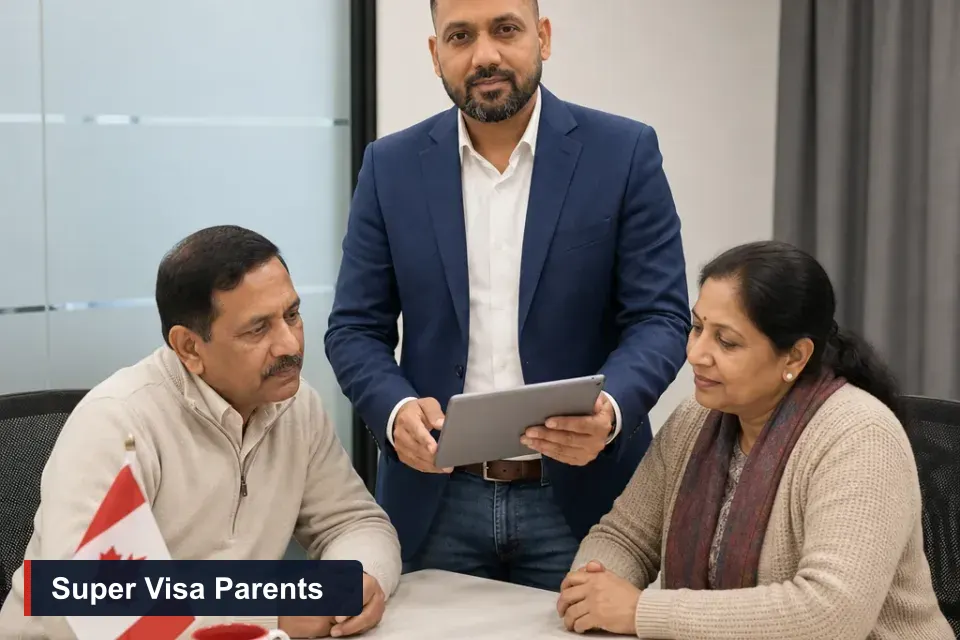
You can apply for a Super Visa for your parents by preparing a complete application package that includes a letter of invitation from you, proof you meet the minimum income requirement, private medical insurance valid for at least one year, the parents' medical exam (if required), identity documents and the application forms requested by IRCC. Submit the application online or at the visa office that serves your parents' country and follow IRCC's instructions; a licensed RCIC can review your package before submission to reduce errors.
What is the Super Visa for parents?
The Super Visa is a special long‑term multiple-entry visa option that lets eligible parents and grandparents visit their family in Canada for extended stays (usually longer than a standard visitor visa per entry). It is a temporary resident permission — not permanent residence — and requires a letter of invitation, proof of private medical insurance from a Canadian insurer, a medical exam when requested, and evidence that the Canadian child or grandchild meets minimum income requirements. Check IRCC’s official “Super Visa” page for the most current rules and details.
Who can apply — eligibility checklist
- Parent or grandparent of a Canadian citizen or a permanent resident (proof of relationship required).
- Has a letter of invitation from the child or grandchild in Canada that includes a promise of financial support and a declaration of responsibility.
- Child or grandchild in Canada meets IRCC’s minimum necessary income (Low‑Income Cut‑Off) for their household size — check IRCC for current figures.
- Private medical insurance purchased from a Canadian insurance company that meets IRCC’s Super Visa requirements (valid for at least one year; confirm minimum coverage amount on IRCC’s page).
- Undergoes a medical examination if IRCC or the visa office requires it.
- Meets general admissibility requirements (no criminality or medical inadmissibility).
Step-by-step: How to apply for Super Visa for parents
- 1Step 1 — Prepare the invitation letter: the Canadian child/grandchild writes a detailed invitation that names the visitors, states the purpose and intended length of stay, gives the host’s contact details, and includes a promise of financial support and accommodation.
- 2Step 2 — Gather sponsor documents: the sponsor collects proof of income (notice of assessment, pay stubs, employment letter), proof of status in Canada (copy of PR card or citizenship document) and any rental/ownership evidence for housing.
- 3Step 3 — Buy private medical insurance: obtain a policy from a Canadian insurer that covers medical care, hospitalization and repatriation for at least one year; confirm the policy meets IRCC’s requirements before purchase.
- 4Step 4 — Book medical exams if required: if IRCC or the visa office requests a medical exam, follow the visa office’s instructions and get the exam from an approved physician.
- 5Step 5 — Complete application forms: the parent completes the visitor visa application package and the specific Super Visa sections where required; complete biometrics forms if requested.
- 6Step 6 — Pay fees and submit: pay the application and biometrics fees and submit the application online or to the local visa application centre (VAC) as directed by IRCC.
- 7Step 7 — Provide biometrics and stay responsive: attend biometric appointments and respond quickly to any IRCC requests for additional documents.
- 8Step 8 — Prepare for travel: if approved, keep originals of the invitation, insurance policy, proof of funds and medical exam results handy to show the border services officer at the port of entry.
Documents you must prepare
- For the applicant (parent/grandparent): valid passport, two passport photographs (per VAC specs), completed application forms, family and travel history, proof of ties to home country (property, return flight booking if available), police certificates if requested, and medical exam results if required.
- For the Canadian sponsor: a signed invitation letter, proof of status in Canada (PR card, Canadian citizenship document or certificate), recent Notice of Assessment from CRA, employment letter or pay stubs, and proof of residence.
- Insurance: the full policy document showing coverage period, benefits, insurer name and confirmation it’s a Canadian insurer; keep the certificate and policy number with travel documents.
- Other supporting documents: proof of relationship (birth certificate, photos, communication history), any evidence of prior visits and the purpose of the visit (family events, caregiving reasons, etc.).
- Translations: any documents not in English or French must be translated and accompanied by a certified translator’s affidavit.
Common mistakes VMC sees — and how to avoid them
- Incomplete invitation letters: avoid one‑line letters. Include full contact details, addresses, duration of stay, explanation of how costs will be covered and a clear promise of financial support.
- Wrong or missing insurance: buying a short-term or non‑Canadian policy can cause refusal. Confirm the insurer is Canadian and the policy meets IRCC’s Super Visa criteria at the time you apply.
- Insufficient proof of sponsor income: submit recent Notices of Assessment and several months of pay stubs; if self‑employed, include business documents and CRA notices.
- Skipping the medical exam when requested: delays or refusals often stem from ignoring medical instructions from the visa office.
- Not preparing original documents for the port of entry: even with pre-approval, officers can ask to see originals of the invitation, policy and proof of funds at the border.
At the port of entry and after arrival
When your parents arrive, the Canada Border Services Agency (CBSA) officer will review their travel documents and may ask to see the invitation, proof of insurance, and evidence the sponsor can financially support them. The officer grants entry and sets the allowed length of stay. Note that having a Super Visa endorsement does not guarantee entry — the border officer makes the final decision. After arrival, keep copies of the insurance policy and the invitation with the visitors, and track the expiry of the authorised stay. If you need a longer stay, consult IRCC guidance on visitor record extensions well before the expiry date.
| Feature | Super Visa | Regular Visitor Visa | Parent Sponsorship (PR) |
|---|---|---|---|
| Purpose | Long visits by parents/grandparents (extended stays) | Short visits (tourism, family, business) up to usual visitor durations | Permanent residence and reunification |
| Typical length of stay per entry | Longer (often up to 2 years per entry) — check IRCC | Shorter (usually up to 6 months or as set by officer) | Permanent residence granted on approval |
| Insurance requirement | Private Canadian insurance required for at least one year | Not required but recommended | Not required for PR application (medical exams apply) |
| Financial support proof | Sponsor must meet minimum income requirement | May be asked for proof of funds | Sponsor signs undertaking and must meet income thresholds for sponsorship |
| Outcome | Temporary entry permission; not PR | Temporary entry permission; not PR | Leads to permanent residence if approved |
Frequently Asked Questions
Can parents apply for a Super Visa from inside Canada?
The Super Visa is normally applied for from outside Canada. If parents are already inside Canada, they should review IRCC guidance on visitor record extensions or consult an RCIC about their options.
How long does the insurance need to be valid?
IRCC requires private medical insurance that covers the whole intended stay and is valid for at least one year when you apply for the Super Visa; check IRCC’s Super Visa page for the current minimum coverage amount and requirements at the time of application.
Does a Super Visa lead to permanent residence?
No. The Super Visa is a temporary visit category. Parents who want permanent residence must apply through family sponsorship programs (Parents and Grandparents sponsorship) or other immigration pathways.
What if the Super Visa application is refused?
If IRCC refuses the Super Visa, the refusal letter will explain reasons. Depending on the grounds, you may correct the issues and reapply or consult a licensed RCIC to consider options such as addressing documentation gaps or applying under a different visitor route.
Always check IRCC’s official “Super Visa” page, the “Visitor visa (Temporary Resident Visa)” instructions, and the IRCC page on medical exams before you apply. Rules and required documents can change and the visa office for your parents’ country may have additional local instructions.
VMC Recommendation
Because Super Visa applications are document-heavy and mistakes are common, ask a licensed RCIC to review your full package (invitation letter, sponsor documents, insurance and the parents’ material) before you submit. A review can catch gaps, correct wording, and reduce the chance of delays or refusal.
Sanjay Singh Kumar
Licensed RCIC · VMC Immigration Services
Sanjay Singh Kumar is a Regulated Canadian Immigration Consultant (RCIC) licensed by the College of Immigration and Citizenship Consultants (CICC). He has guided thousands of clients through Express Entry, PNP, work permits, and family sponsorships.