
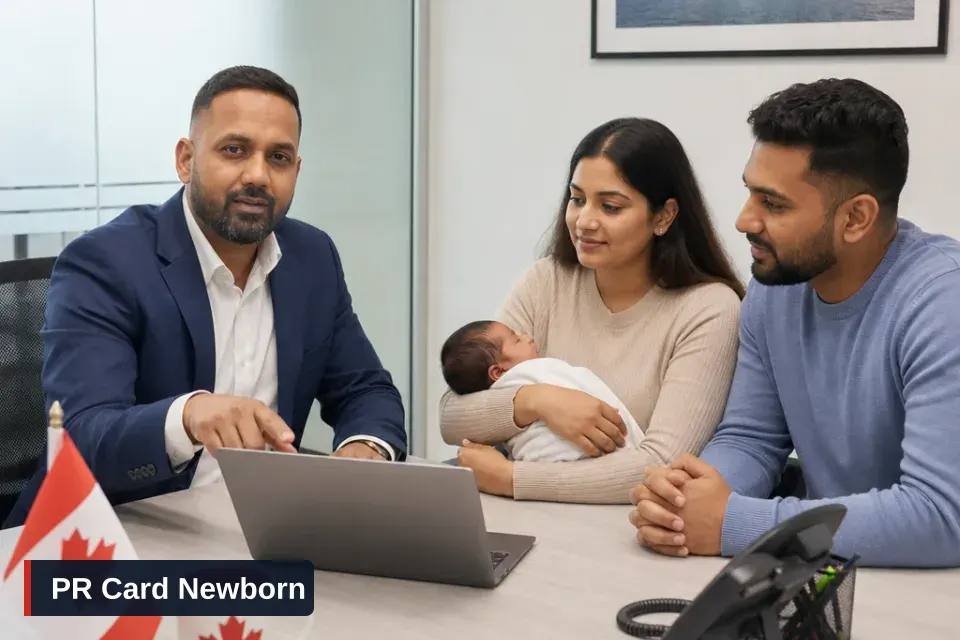
If your baby is born outside Canada after you became a permanent resident, the child is not automatically a permanent resident — you will need to secure PR status for the child or confirm that the child was already included in an earlier PR application. If the child already has PR status (for example, was included in the original application and has a COPR or record of landing), you can apply for a permanent resident card for them; if not, you must take steps to give the child PR before a PR card is possible.
Does my baby born abroad automatically have Canadian PR?
No — being born outside Canada does not make a child a permanent resident even if one or both parents are permanent residents. That is different from Canadian citizenship by birth (which applies to most babies born in Canada). The exception is if your child was included on your original PR application and IRCC processed the child as a dependent before you landed — in that case the child already has PR status and can receive a PR card.
If the newborn already has PR status: steps to get a PR card
- 1Confirm the child’s PR status: locate the child’s Confirmation of Permanent Residence (COPR), record of landing (if issued), or other official IRCC confirmation showing the child is a permanent resident.
- 2If the child is outside Canada with a COPR or valid PR visa: arrange travel to Canada using the COPR/visa. If IRCC issued a COPR but the child is outside and needs permission to travel, you may need a Permanent Resident Travel Document (PRTD) at a Canadian visa office — check the IRCC page ‘Apply for a permanent resident travel document’.
- 3If the child is in Canada: apply for a permanent resident card on their behalf using IRCC’s ‘Apply for a permanent resident card’ instructions. Typical documents you will need include the child’s proof of PR status (COPR or record of landing), the child’s passport, two Canadian-style photos that meet IRCC rules, and identity documents (birth certificate or parent’s documents).
- 4Follow IRCC biometrics and mailing instructions. Biometrics rules vary by age — check the IRCC page before you submit.
- 5If the child is outside Canada and cannot travel immediately: apply for a PRTD so they can return to Canada. After arrival, submit the PR card application from inside Canada.
Important: a PR card is issued only to people who already hold PR status. If you cannot find a COPR or you are unsure whether IRCC processed the child as a dependent, do not submit a PR card application — first confirm PR status with IRCC or an RCIC.
If the newborn does not have PR status: how to secure PR for your baby
If the child was not included on a PR application and was born abroad after you became a permanent resident, the child will not have PR status and cannot get a PR card until you secure PR for them. There are two common approaches:
- Add the child to an existing PR application: if your PR application is still in process and the child was born before final decision, contact IRCC immediately to add the child as a dependent. IRCC has rules for adding dependent children during processing — check the IRCC sponsorship or application-specific pages.
- Sponsor the child as a dependent (family class): if the child is already born and you are a landed PR, you can typically sponsor the child for permanent residence. The sponsoring process and whether you apply inland or outland will depend on your family situation and the child’s current location. While you wait for a decision, you may need a travel solution to bring the child to Canada (visitor visa or PRTD is not available until they are a PR).
Note: If the child is not a PR, they can still travel to Canada on a visitor visa (if eligible) but that does not give PR status. Sponsorship and PR decisions can take time — plan travel and documentation accordingly.
Documents checklist: what you will commonly need
- Proof of the child’s identity: passport or national identity document.
- Proof of the child’s birth: long-form birth certificate showing parent(s) names (translated and certified if not in English/French).
- Proof of the child’s PR status (if they are already a PR): COPR, record of landing, or previous PR card.
- Parents’ proof of PR status: copies of parent(s)’ PR cards, COPRs or passports showing landing.
- Photos meeting IRCC specifications for a PR card application.
- If sponsoring: documents to prove parent–child relationship and sponsor’s eligibility (ID, proof of status, any forms IRCC requires).
- If travelling from outside Canada: any required visa or PRTD paperwork as directed by IRCC.
Common mistakes VMC sees — and how to avoid them
- Assuming a baby born abroad becomes a PR automatically — always verify IRCC processing or include the child while the application is active.
- Applying for a PR card for a child who does not yet have PR status — this leads to refused applications and delays. Confirm PR status first.
- Not getting a travel document when needed — a COPR or PR visa is not the same as a PR card, and some children will need a PRTD to travel to Canada if they are outside Canada and already PRs.
- Using incorrect photo sizes or incomplete identity documents — follow IRCC photo and ID rules closely to avoid rejections.
- Failing to translate and certify non‑English/French documents — missing certified translations can delay processing.
Quick comparison: baby already PR vs baby not PR
Where to check official guidance
Always confirm specifics on the Government of Canada pages before you apply. Useful IRCC pages include: 'Apply for a permanent resident card', 'Apply for a permanent resident travel document (PRTD)', and 'Sponsor a dependent child'. If you applied through a specific program, also check the IRCC page for that program (for example, sponsorship versus economic-class instructions). IRCC requirements and forms change from time to time — if a deadline or fee is important in your case, check the IRCC website for the current information.
Frequently Asked Questions
Can my newborn travel on my passport to Canada?
No. Most countries require each traveller, including infants, to have their own passport. If your baby is not a PR, they may also need a visitor visa to enter Canada. If the baby is a PR and outside Canada, you may need a PRTD to travel — check the IRCC PRTD page.
Can I get a PR card for my newborn from outside Canada?
A PR card is normally issued to permanent residents who are in Canada. If your child is already a PR but is outside Canada, the common path is to get a PRTD from a Canadian visa office so the child can travel to Canada; once in Canada, you apply for the PR card. Confirm the correct process on the IRCC page 'Apply for a permanent resident card'.
What if my child was included in my PR application but we can’t find the COPR?
If you believe IRCC processed the child as a dependent but you cannot find a COPR or record of landing, contact IRCC through their web form or call centre to request confirmation. Do not file a PR card application until you have official proof of the child’s PR status.
Can I sponsor my child from inside Canada?
Sponsorship rules depend on where you and the child are located. Some sponsorship streams allow inland applications; others are outland. Check the IRCC page 'Sponsor a dependent child' for the options that match your situation and consult an RCIC if your case is complex.
VMC Recommendation
If your newborn was born outside Canada and you are unsure about their PR status, book a review with a licensed RCIC (Sanjay Singh Kumar at VMC Immigration). We can confirm whether the child already has PR, advise whether you need a PRTD or sponsorship, and review your documents before you submit to IRCC to avoid delays.
Licensed RCIC · VMC Immigration Services · CICC R705959
Sanjay Singh Kumar is a Regulated Canadian Immigration Consultant (RCIC) licensed by the College of Immigration and Citizenship Consultants (CICC). He has guided thousands of clients through Express Entry, PNP, work permits, and family sponsorships.
Follow our updates on Google: add VMC as a preferred source to see our immigration news more often in Google Top Stories.