
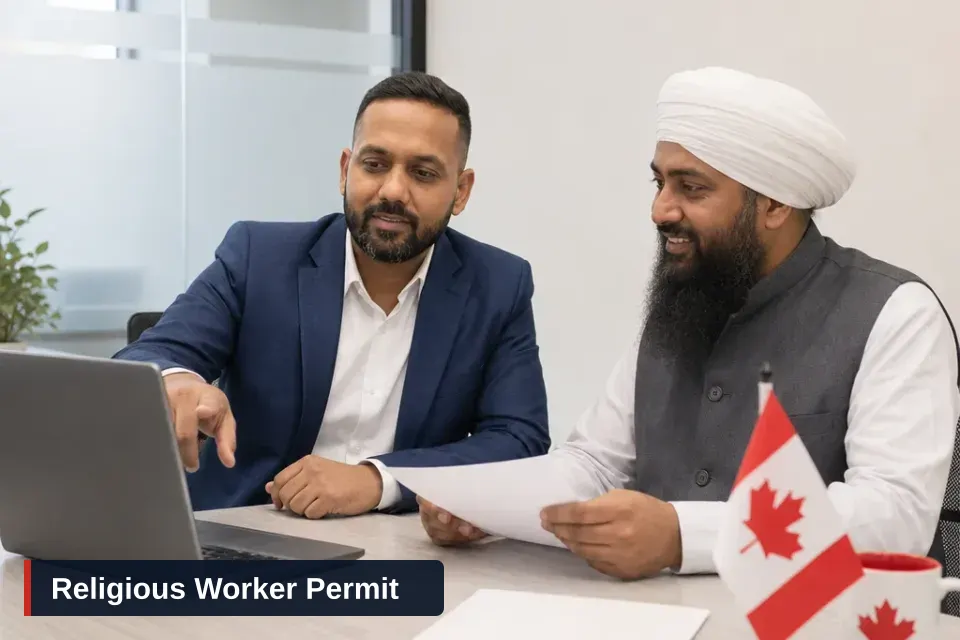
Yes — you can apply for a temporary work permit to work in Canada as a religious worker. Whether your employer must get an LMIA (Labour Market Impact Assessment) or can use an LMIA exemption depends on the job, the employer’s status and the rules that apply to your country of residence; below you’ll find the practical steps, checklists and common mistakes to avoid.
Who counts as a "religious worker"?
IRCC does not offer a single one-line definition you can quote in every case — but in practice religious workers include people hired to perform religious or faith-based duties for a congregation or faith-based organisation. Common examples are:
- Ordained clergy, imams, priests or ministers
- Lay leaders, youth ministers, Sunday school teachers and religious educators (paid roles)
- Music ministers, worship leaders and choir directors employed by a religious organisation
- Religious counsellors and chaplains (hospital, prison or institutional chaplaincy paid by faith groups)
- Support paid roles directly tied to religious programming (paid community outreach coordinator, administrative staff employed by the religious body)
Two main routes: LMIA-based or LMIA-exempt
There are two common paths for a religious-worker work permit: the employer applies for an LMIA to hire a temporary foreign worker, or the employer and role qualify for an LMIA exemption. Which route fits your case affects timing, employer duties and what you must submit with your application.
| Feature | LMIA route | LMIA-exempt route |
|---|---|---|
| Who applies | Employer applies to ESDC for an LMIA; employer shows recruitment and need | Employer provides a job offer and proof it fits an LMIA-exempt category (e.g., significant benefit, international agreement) — check IRCC/ESDC guidance |
| When used | Common when employer cannot fit an exemption and must demonstrate no Canadian can fill the position | Used if a specific exemption applies (depends on role, international agreements or ministerial exemptions) |
| Employer responsibilities | Stronger recruitment record, wage and working condition details, employer compliance obligations | Still must provide clear job offer, supporting documents and compliance with IRCC rules |
| Worker impact | Work permit issued on basis of positive LMIA and job offer | Work permit issued based on LMIA exemption code and job offer; documents differ |
Step-by-step: what the employer must do
- 1Confirm the job duties and NOC (occupation) that best match the position — accurate job classification matters for both LMIA and exemptions.
- 2Decide whether the position requires an LMIA by checking ESDC/IRCC guidance for religious or faith-based roles; if unsure, seek advice before recruiting.
- 3If an LMIA is required: advertise the job and keep recruitment records (where you advertised, duration, responses, reasons Canadian applicants were not hired) and submit an LMIA application to ESDC with required employer documents.
- 4If using an LMIA exemption: prepare a clear job offer and the evidence that supports the exemption (organisational mandate, international agreement details, or other exemption criteria).
- 5Provide the worker with a detailed written job offer and employment contract showing wages, hours, duties, start date and employer contact details.
- 6When the LMIA is approved (if applicable) or exemption documentation is ready, issue the job offer and any LMIA copy or exemption letter the worker needs to include in their application.
Step-by-step: what the religious worker must do
- 1Get a complete job offer and employer documentation (LMIA or written explanation of exemption).
- 2Gather identity documents (passport), two recent photos (if required by the online form), and proof of civil status.
- 3Collect documents evidencing your role and qualifications: letters from your employer, evidence of religious training or ordination (if applicable), CV and reference letters from previous religious employers.
- 4Prepare supporting documents: police certificates, medical exam reports (if IRCC requires a medical), and proof of funds if IRCC asks for evidence you can support yourself on arrival.
- 5Submit the work-permit application online (or at a visa office if required by your country). Include the job offer, LMIA or exemption evidence, and all supporting documents.
- 6Provide biometrics and attend any required interviews or medicals. Wait for a decision and, if approved, follow instructions on how to get your permit issued (port of entry letter or visa as applicable).
Eligibility checklist & documents to prepare
- Valid passport with at least the duration of the intended stay
- Signed job offer and employment contract with duties, hours, wages and start date
- A copy of a positive LMIA or written evidence explaining which LMIA exemption applies
- Proof of your religious credentials or experience (ordination certificate, letters from religious authority, course diplomas, previous employment references)
- Detailed CV and reference letters from previous employers describing duties and dates
- Police certificates from countries where you lived for extended periods, if requested
- Medical exam results when IRCC requires them (e.g., certain health-related roles or residence plans)
- If you plan to bring family: marriage certificate, birth certificates and separate applications or documents for spouse and dependants as required
Common mistakes and how to avoid them
- Weak job descriptions — mistake: vague duties that don’t show this is a paid religious role. Fix: provide a clear, detailed job description tied to religious functions.
- Missing recruitment evidence when an LMIA is needed — mistake: employer fails to document where and how they tried to hire Canadians. Fix: keep copies of ads, dates, applications and reasons for rejection.
- Relying on the wrong exemption — mistake: assuming an exemption applies without checking IRCC/ESDC criteria. Fix: confirm the exact exemption code and keep the supporting proof in writing.
- Insufficient proof of religious credentials — mistake: only a brief letter from the employer. Fix: add ordination papers, course records, multiple reference letters and samples of previous work (e.g., program flyers).
- Applying with incomplete police or medical records — mistake: delays or refusals from late documents. Fix: obtain police certificates early and schedule medicals if there’s any chance IRCC will request one.
Applying from inside Canada vs outside Canada: what to expect
You can apply for a work permit from outside Canada or, in some situations, from inside Canada. If you’re already in Canada on another status (study or work), your options and eligibility rules differ and you may need to change your status before starting work. Also remember that spouses and dependants need separate applications (work, study or visitor) and eligibility depends on your specific permit type. For exact rules and the application process check IRCC’s “Work in Canada as a religious worker” page and the ESDC LMIA guidance.
Frequently Asked Questions
Can my spouse work in Canada if I get a religious worker permit?
Short answer: possibly. Spouses can apply for work or study permits depending on the type of main applicant’s permit and IRCC rules at the time. Each case is different — you should prepare a spouse application with evidence of your relationship and your own permit details.
Do volunteers need a work permit?
Unpaid volunteers doing genuine volunteer work for a non-profit or religious group often do not need a work permit. However, if the role is paid or would normally be done by a paid worker, a work permit is required. If you’re unsure whether the position counts as volunteer work, get advice before travelling.
Will language tests or credential assessments be required?
There is no automatic language-test rule for religious worker permits, but employers may request proof that you can perform duties in English or French. Certain roles that require professional certification may also need credential assessment — check the employer’s requirements and mention them in the job offer.
Can religious work lead to permanent residence?
Yes — some religious workers may later qualify for permanent residence through provincial nominee programs, Express Entry (if they meet criteria) or other employer-driven streams. Eligibility depends on occupation classification (NOC), work experience, language, education and provincial rules.
VMC Recommendation
Religious-worker applications often hinge on clear job descriptions and the employer’s proof. We recommend you have a licensed RCIC review the job offer, LMIA/exemption choice and your documents before you apply to reduce delays and avoid common mistakes.
Licensed RCIC · VMC Immigration Services · CICC R705959
Sanjay Singh Kumar is a Regulated Canadian Immigration Consultant (RCIC) licensed by the College of Immigration and Citizenship Consultants (CICC). He has guided thousands of clients through Express Entry, PNP, work permits, and family sponsorships.
Follow our updates on Google: add VMC as a preferred source to see our immigration news more often in Google Top Stories.