
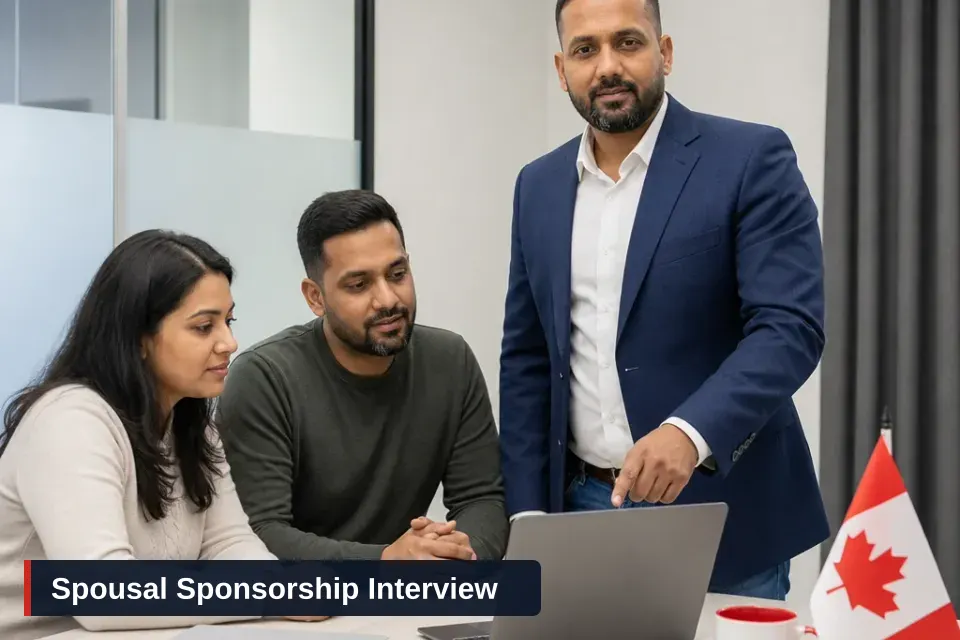
Yes — IRCC may ask for a spousal sponsorship interview, but most applications are decided without one. If you are invited, the interview is usually to verify the genuineness of your relationship or clear up information; it is not automatically a sign of refusal.
Why does IRCC ask for a spousal sponsorship interview?
IRCC asks questions or requests an interview when a visa officer needs more evidence to assess whether a sponsored relationship is genuine, or to clarify details about identity, past marital history, criminality, or admissibility. An interview can be requested at any stage — while processing onshore or offshore — and in different formats (in person, by phone or by video).
How will the interview be scheduled and who should attend?
IRCC or the visa office handling your file will send an interview request by email or to your online account. The request will say the date, time, format and who should attend. Usually both the sponsor (in Canada or abroad) and the sponsored person attend if possible. If someone cannot attend, explain why and ask the visa office what substitute arrangements are allowed.
Common spousal sponsorship interview questions
- How did you meet? Give dates, places and key events.
- When and where did your relationship become intimate/official?
- Details about your wedding/commitment ceremony: date, guest names, venue, who paid.
- Describe a typical weekday and weekend in your life together.
- Who pays which bills, and where are joint accounts held (if any)?
- Names and relationships of people close to you (friends, relatives) and how often you see them.
- Questions about prior marriages, children, custody arrangements and supporting documentation.
- Questions to the sponsor about employment, income and ability to support the sponsored person.
- Questions of identity and travel history: previous addresses, country of residence, periods apart.
Documents to bring: a practical checklist
- 1Passport and government ID originals for both of you.
- 2Marriage certificate or proof of common-law relationship (photos, lease, joint bills).
- 3Proof of cohabitation where relevant: leases, utility bills, mail addressed to both names.
- 4Photos together across time and with family/friends (caption each with date/place).
- 5Communication records showing regular contact (printouts of chats, call logs, emails) — highlight key threads.
- 6Travel records: flight itineraries, entry stamps or tickets showing visits.
- 7Financial evidence: joint bank statements, shared insurance, remittances, or bills showing shared expenses.
- 8Affidavits from friends/family can help but must be specific and signed.
- 9Any documents listed in IRCC's interview request — bring originals and a simple set of photocopies for the officer.
Prepare one labelled folder with originals and one photocopy folder to hand to the officer. Keep anything private or unrelated out of the folders to avoid confusion.
How to prepare: step-by-step before, during and after the interview
- 1Before the interview:
- 21) Review your application together. Both partners should read the same statements and attachments so answers don’t conflict.
- 32) Create a one-page timeline of your relationship (meeting, milestones, cohabitation, trips, wedding) to review and bring.
- 43) Organise documents in date order and label them—makes finding proof quick during the meeting.
- 54) Rehearse speaking naturally — practice answering key questions concisely (avoid rehearsed scripts).
- 65) Prepare for technical/logistical details if interview is by phone or video: test the connection, ensure a quiet private room, and have documents to hand.
- 7
- 8During the interview:
- 91) Listen carefully, answer the question asked, and keep answers clear and honest.
- 102) If you do not understand a question, ask the officer to repeat or clarify.
- 113) Do not volunteer extra details that are not asked; focus on accuracy.
- 124) If you need to refer to a document, tell the officer which exhibit (e.g., “see photo folder, page 3”) and hand it over.
- 13
- 14After the interview:
- 151) Note any follow-up documents requested and the submission deadline in writing.
- 162) Send additional documents exactly how IRCC instructs (online account upload, email to the visa office, or mail).
- 173) Keep copies of everything you submit and the tracking/receipt numbers.
Common mistakes VMC sees — and how to avoid them
- Inconsistent answers: partners give conflicting facts (dates, addresses). Fix by reviewing the application together before the interview.
- Over-reliance on scripted answers: sounding rehearsed can make an officer more suspicious. Be truthful and conversational.
- Bringing irrelevant third parties or too many people: only attend if asked; bring a certified interpreter if needed.
- Forgetting ID or original documents listed in the interview notice — always double-check the list.
- Submitting new, unexpected evidence after the interview without context — explain why it wasn’t submitted earlier.
In-person vs phone vs video interviews — quick comparison
What happens after the interview?
After the interview the officer may: decide the file based on the interview and existing documents, request more information or documents, or schedule another interview. IRCC will notify you or update your online account. A single interview does not determine the final outcome by itself — it is one piece of evidence among all documents and checks.
Frequently Asked Questions
Can an interview lead to a refusal on its own?
An interview can contribute to a refusal if the officer concludes the relationship is not genuine or if other admissibility issues arise. However, refusal decisions rely on the full record — documents, background checks and interview evidence — not just the interview.
Can I bring my lawyer or RCIC to the interview?
You may request to have your representative present, but IRCC’s permission is not automatic. Inform the visa office ahead of time if you want a representative or interpreter to attend and follow their instructions.
Will the interview be recorded?
Officers keep notes and may record details in the file. Audio or video recording by applicants is generally not permitted unless IRCC explicitly allows it. Always ask the officer if you need clarification about notes or statements.
What if I can’t attend at the scheduled time?
Contact the visa office or use your IRCC online account as soon as you can to explain and request rescheduling. Provide a reason and propose alternative times; keep records of your communication.
Official pages to check: IRCC's 'Sponsoring your spouse, partner or child' page and the visa office webpage named in your online account. Always follow the instructions in the interview notice you received.
VMC Recommendation
If you’ve been called for a spousal sponsorship interview, consider having a licensed RCIC review your application and the interview request with you. A review can help spot inconsistencies, prepare a concise timeline and checklist, and suggest practical answers — without promising outcomes. Contact Sanjay Singh Kumar, RCIC at VMC Immigration in Brampton for an in-person or online consultation.
Licensed RCIC · VMC Immigration Services · CICC R705959
Sanjay Singh Kumar is a Regulated Canadian Immigration Consultant (RCIC) licensed by the College of Immigration and Citizenship Consultants (CICC). He has guided thousands of clients through Express Entry, PNP, work permits, and family sponsorships.
Follow our updates on Google: add VMC as a preferred source to see our immigration news more often in Google Top Stories.