
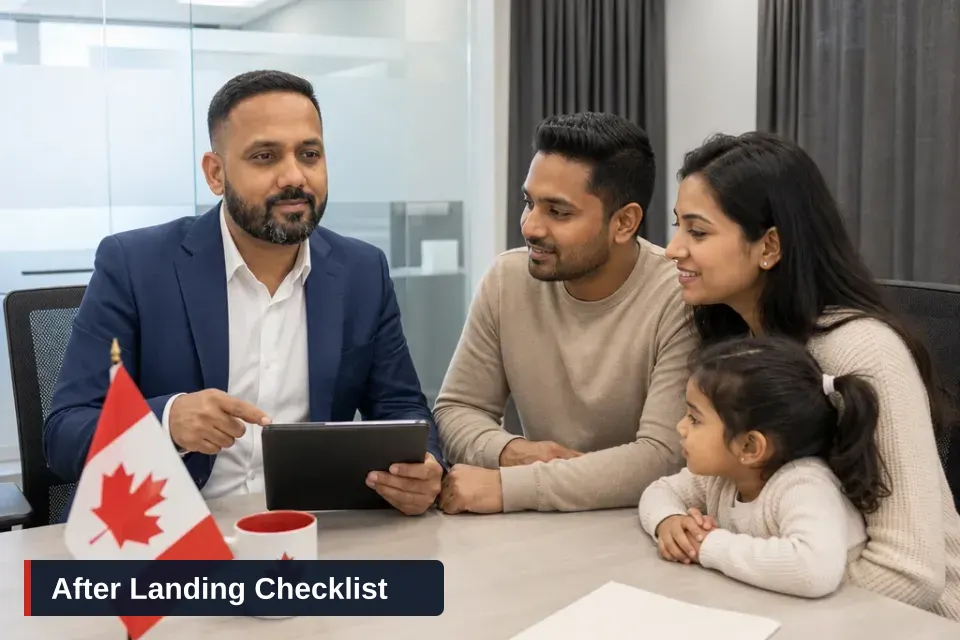
Right after you land in Canada, the most important things are to confirm your permanent resident (PR) status at the port of entry and make sure IRCC has the address where you want your PR card mailed. After that, focus on critical practical tasks: apply for a Social Insurance Number (SIN), register for provincial health care, open a bank account, and start any licensing or credential steps you need for work.
What to do at the port of entry (arrival formalities)
At the airport or land border, a Canada Border Services Agency (CBSA) officer will check your passport and Confirmation of Permanent Residence (COPR). Make sure the officer stamps your passport (if required), confirms your name and date of birth, and records the Canadian address where you want the PR card sent. Keep your COPR and passport with you — they are essential documents.
Apply for your PR card and what to expect
- Confirm the mailing address recorded by the CBSA — IRCC will use that to mail your PR card.
- If you need the PR card sooner or you’re already outside Canada, you may need a Permanent Resident Travel Document (PRTD) — check the IRCC page for PRTD for the rules.
- Keep your COPR safe; you may need it later when applying for a PR card replacement or for other official steps.
- If any personal details (name, date of birth) were recorded wrong at the port of entry, tell the CBSA officer immediately and ask for correction instructions.
Official pages to check: IRCC’s information on "What to do after becoming a permanent resident" and the IRCC page about the PR card and Permanent Resident Travel Document (PRTD).
First-week tasks: ID, SIN, bank, phone and basics
- 1Apply for a Social Insurance Number (SIN) at a Service Canada office or online if eligible — you need a SIN to work and to file taxes.
- 2Open a Canadian bank account (bring passport, COPR and address proof).
- 3Get a local SIM card or activate a Canadian phone plan so you can receive calls and texts about applications and services.
- 4Keep originals and make clear scans or photos of your passport, COPR, marriage certificate and children’s birth certificates.
- 5Start the job search and prepare Canadian-style documents: update your CV, collect Canadian-style employment references, and prepare credential evaluations if needed.
First month: health coverage, provincial ID, taxes and benefits
Health-care registration, a provincial ID or driver’s licence, and tax registration are top priorities in your first month. Each province has different processes and possible waiting periods for coverage, so start these steps early.
- Register for provincial health insurance (for example, ServiceOntario in Ontario). Check your province’s health ministry website for eligibility and required documents — some provinces have a waiting period.
- Apply for a driver’s licence or provincial photo ID — this is often needed for daily life and work.
- Set up your tax accounts: learn when and how to file taxes as a new PR and keep records of your arrival date and documents.
- Look into child benefits and family supports if you have children — apply through the Canada Revenue Agency (CRA) for benefits when you file taxes or set up CRA accounts.
Work and credential steps: how to get job-ready as a newcomer
If you plan to work in a regulated profession (health, engineering, teaching, trades), start the licensing or credential-recognition process as soon as possible; those processes can take months. If your occupation is not regulated, preparing Canadian-style references and networking locally speeds job search results.
- Check the regulator for your profession (for example, nursing college, engineering association) for licensing steps and required exams.
- Order an Educational Credential Assessment (ECA) if you haven’t already and if you will need it for licensing or for Express Entry in the future (ECA is done by designated organizations).
- Prepare Canadian-style reference letters and employer contact information — IRCC and some employers prefer specific formats, so keep clear, dated records.
- Look into upgrading courses, bridging programs for internationally trained professionals, or newcomer employment services in your city.
Common mistakes newcomers make — and how to avoid them
- Not checking the mailing address recorded at arrival — if IRCC has the wrong address, your PR card can be delayed or returned.
- Delaying SIN or bank account setup — employers will need your SIN and a Canadian bank account to start payroll.
- Assuming health coverage starts immediately — many provinces have a waiting period; buy private coverage if you need immediate access to care.
- Mixing up official documents — keep original documents safe and make certified translations if documents aren’t in English or French.
- Waiting to start credential recognition — regulated professions often take the longest, so start immediately.
First-week / First-month / First-six-months checklist (comparison)
| When | Priority tasks | Why it matters |
|---|---|---|
| First 24–72 hours | Confirm CBSA record, keep COPR and passport, confirm PR card mailing address | You need proof of status and correct mailing details for your PR card |
| First week | Apply for SIN, open bank account, get phone, collect documents | Start work eligibility and daily life essentials |
| First month | Register for provincial health, apply for driver’s licence/ID, set up CRA accounts | Access health care and public services; prepare taxes and benefits |
| First 3–6 months | Start credential recognition or licensing, look for jobs, enroll children in school | Longer processes start now — they affect your ability to work in your trained profession |
Frequently Asked Questions
How long before I get my PR card after I land?
Timing for a PR card varies and depends on IRCC processing at the time you apply. IRCC’s PR card page has current processing guidance; keep your COPR and a valid address on record so IRCC can mail the card to you.
Can I start working immediately after I land?
Yes — as a permanent resident you have the legal right to work in Canada immediately, but most employers will ask for a SIN. Apply for your SIN right away at Service Canada.
What if I lose my COPR or passport after landing?
If you lose a COPR inside Canada, keep records of the loss and seek guidance about replacing or proving your status. For travel, losing your passport may require consular help from your home country; if you are outside Canada without a PR card, you would need a PRTD to return. Contact IRCC and check their pages for replacement steps.
Do I need to tell IRCC if I change my address after landing?
Yes. You must update IRCC with your Canadian address so the PR card can be delivered and so IRCC records are accurate. Use the IRCC ‘change of address’ service and keep a record of the confirmation.
VMC Recommendation
After you’ve completed the immediate steps, consider booking a review with a licensed RCIC to check your documents and timelines for credential recognition or provincial registrations specific to your occupation and province. A short RCIC review can identify important issues early and point you to the right official IRCC or provincial service pages for your situation.
Licensed RCIC · VMC Immigration Services · CICC R705959
Sanjay Singh Kumar is a Regulated Canadian Immigration Consultant (RCIC) licensed by the College of Immigration and Citizenship Consultants (CICC). He has guided thousands of clients through Express Entry, PNP, work permits, and family sponsorships.
Follow our updates on Google: add VMC as a preferred source to see our immigration news more often in Google Top Stories.